HR · 4 min read
From Applicant to Employee: Why One Platform Beats Three Tools
What a split recruitment, contract and HR setup costs, what you gain when applicant to employee runs on one platform, and how to switch step by step.
Published · By Marco Sterringa
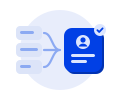
A new hire's first day looks simple from the outside. Behind it, their details have usually passed through three separate systems: one to find and screen them, one to send and sign the contract, and one to run their employment. Each system holds a slightly different copy of the same person.
That split is normal, and it is also where time and accuracy leak away. Names are retyped, salaries are re-entered, and context stays behind in an inbox. This article looks at what the three-tool setup costs, what changes when the journey from applicant to employee runs on one platform, and how to move there without replacing everything at once.
The three-tool setup most employers run
In many companies, the journey from applicant to employee is stitched together from three kinds of tools:
- A recruitment tool. A job board, a spreadsheet or an applicant tracking system, where CVs are collected, screened and compared.
- A contract and communication tool. Email or a chat app for messages and interview times, plus an e-signature service for the employment contract.
- An HR tool. A system or a set of files for the employee record, shifts, leave, expenses and pay slips.
Each tool does its own job well enough. The trouble is the handover between them. Every time a person moves from one tool to the next, someone has to carry their information across by hand, and every extra subscription adds another login, another bill and another place to check.
What breaks between the tools
The cost of a split process rarely shows up as one big failure. It shows up as small, repeated friction:
- Retyping. The candidate's name, contact details, salary and start date are entered once in the recruitment tool, again in the contract, and again in the HR system. Every re-entry is a chance for a typo in a figure that matters, such as pay.
- Lost context. The reasons you chose this person, the interview notes and the screening answers stay in the first tool. When a manager later asks why someone was hired, nobody can find out.
- Version confusion. A signed contract sits in one inbox, an updated offer in another. Which one is current?
- Access gaps. Each tool has its own permissions. A hiring manager may see every vacancy in one system and none in another, and removing a leaver's access means checking three places.
- Delay at the handover. The first day arrives before the employee record exists, so the new hire has no schedule, no clock-in and no way to submit a document.
None of these is dramatic alone. Together they make every hire slower than it needs to be.
One platform, from applicant to employee
On JobsJai, the same record follows the person through every stage, so nothing has to be carried across by hand:
- Find and rank. Post the vacancy, upload CVs in bulk, and see every applicant ranked by fit, with an AI candidate brief for each.
- Chat and interview. Messages, screening answers and interview times live in the chat with the candidate, so the history stays attached to the person.
- Offer and sign. Send the offer with the contract attached, with salary, start date and notes. The candidate signs on their phone, and JobsJai records the time, IP address and device.
- Create the employee file. Salary and start date come straight from the signed offer into the employee file, with no re-entry.
- Run the team. Documents, onboarding checklists, shifts, clock-ins, leave, expense claims and payslips all hang off that same file. Employees use JobsJai Work on their phone.
- Keep control. Roles decide who sees which vacancies and HR areas, and an activity log shows who changed access.
The key moment is step four. In a three-tool setup, this is where someone opens a spreadsheet. Here, it happens on its own.
What you gain
The benefits follow directly from removing the handovers:
- Speed. The employee file exists the moment the contract is signed, so onboarding can start before the first day.
- Accuracy. Pay and start date are entered once, in the offer, and reused everywhere. There is one source for the figures that matter most.
- A full history. From the first CV to the latest payslip, one record shows what happened and when, including every change to the employment.
- Simpler access control. One set of roles and one activity log, instead of three permission systems to keep in step.
- Fewer subscriptions and logins. One platform to learn, one place to ask for help, and one bill to review.
These gains grow with the number of hires. A company that hires a few people a year may feel only some of them. One that hires continuously, or across several teams, feels them every week.
Switching without replacing everything
Moving to one platform does not have to be a single, risky cutover. A gradual path works well:
- Start with recruitment. Use bulk CV upload and ranking for your next vacancy, and keep your current HR tools for now.
- Bring your team in when ready. Import up to 5,000 employees from a CSV or Excel file on the web. The columns are matched for you, and everyone is invited to JobsJai Work.
- Switch on only what you need. Each company can turn HR modules on or off, such as payslips, clocking in and out, or reviews.
- Connect your own systems. The developer portal offers API keys and webhooks for new applications, status changes and matches.
One person, one record
A hire is one person with one story, from the first CV to the first payslip. Tools that split that story make you rebuild it at every handover. A single platform keeps it whole, and gives your team back the time spent copying it across.
JobsJai is coming soon to Thailand. To be among the first to try recruitment and HR in one platform, email info@jobsjai.com for early access.